
Pocket Dunj is a cards-only dungeon adventure party game for 2-5 players!
1 player assumes the role of the Chief Dungeon Executive, aka “the “Chief”, using a Dunj deck to play monsters, traps, and events!
The remaining players assume the role of Adventurers, using a variety of Adventurer decks to take on the Dunj!
The goal of the Chief is to “injure” every Adventurer in the party by subjecting them to the machinations of the Dunj!
The goal of the Adventurers is to survive the entire Dunj Deck with at least one uninjured Adventure!

One player will act as the Chief, and select any Dunj Deck! Separate the Dunj title card and the Final Act deck from the main deck and utilize the layout in the image.
Be mindful of the Dunj Difficulty when selecting a Dunj Deck:
The Chief begins the game with a deck, a Dunj title card, and a Final Act deck.
When the Adventurers successfully deal with monsters and traps, or the Chief plays and resolves an event, they go into the discard pile - unless a card states otherwise!
When the Adventurers “shove” a monster or trap, they go into the shove pile! (see “Shove”.)
The Final Act deck comes into play if and when the Adventurers make it through the Dunj deck! (see “The Final Act”.)

The remaining players will act as Adventurers, and each selects an Adventurer deck. Separate the title card and utilize the layout in the image.
All Adventurers begin the game with a deck and an Adventurer card. Utilize the above layout for readability.
When an Adventurer plays a card, it goes into their discard pile - unless a card says otherwise! Make sure the discard deck is tilted sideways for readability. The discard pile is shuffled into a new deck if the Adventurer goes to draw a card and cannot!
When an Adventurer is damaged, they put cards equal to the damage they took off the top of their deck and into their damage pile! The Adventurers will be interacting with their damage piles, so make sure the cards are vertically spread so that the topmost card names are visible.

When the Dunj is empty, the Chief no longer has any cards in hand, and no more cards to draw, the Adventurers win!
When an Adventurer has taken a certain amount of damage, they become “Injured”! They flip over their Adventurer title card to indicate this. When all Adventurers are injured, the Chief wins!
The amount of damage that injures an Adventurer, as well as all player’s hand size, is determined by the amount of players - this includes the Chief, who is also considered a player!
For example, in a 3 Player game:
Consult and utilize the included Win Condition reference cards!

It is possible to play with just 2 players! The Chief player uses a Dunj deck and plays like normal, but the Adventurer player selects 2 Adventurer decks and plays them both!
They maintain a hand size of 8, and in the Draw phase, they draw up to 4 cards from each Adventurer deck! The game otherwise functions like normal!
Note that 2 player Pocket Dunj is no less strategic or engaging! However, due to the Chief’s smaller hand size, playing through a standard 40 card Dunj deck might take a little longer than usual depending on the player's experience and confidence levels.
If players ever wish to reduce the game time, they may do so in the following ways:
Each turn in Pocket Dunj has 3 phases:
In the Draw Phase, every player draws to their hand size! Any player, once per draw phase, may discard any amount of cards and then re-draw to their hand size!
If an Adventurer begins this phase with more cards in their hand than their hand size, they do not draw any cards. Note that the Chief can never exceed their hand size!
During the Adventure Phase, the Chief uses the cards in their hand to create “Encounters” that the Adventurers manage with the cards in their hand.
To create and run an Encounter:
The Chief ends the Encounter when they have run out of cards to play, or the Adventurers declare they are done playing cards! This can be because they have dealt with all monsters and traps, or don’t have any more cards to play, or because they are saving cards for a possible future encounter.
However, instead of building another encounter at the end of an encounter; the Chief may decide to advance the Adventure Phase to the Dunj Phase! The Dunj Phase is when Monsters and Traps do damage, so the Adventurers need to be certain they are done playing cards when there are monsters and traps still in the Dunj!
The Chief must always play at least 1 encounter per turn, but can make any many additional encounters as they wish using any cards still in hand.
In the Dunj Phase, any Monsters and Traps remaining in the Dunj do damage and their Dunj Phase effects resolve! There can be other cards in the Dunj that resolve during the Dunj Phase, so that happens as well!
Start a new turn at the draw phase, and repeat until game completion!

Every Adventurer and Dunj deck has a title card that sits in front of the deck. It primarily serves as a reminder for what deck is being played, but for the Adventurers, it creates a space to place monsters so that engagements are very clear to all players! (see "Engagements")

All Adventurer cards, as well as some of the Chief’s, contain “Actions”.
Actions can be Skills, Spells, Reactions, Bombs, or Events! Some cards have multiple actions - when playing these cards, only one of these actions can be executed, and then the card is discarded!

Cards with a bomb action immediately affect the game when they are drawn, usually in chaotic and destructive ways!
Note that the back of all bomb cards are marked so everyone can see them before they are even played!
Adventurers - when a bomb is moved from your deck to your damage or discard pile because a card forced it, the bomb does not go off!
If for whatever reason an Adventurer refuses to draw or play a bomb, they take 1 billion damage!
If for whatever reason the Chief refuses to draw or play a bomb, the Adventurers win!
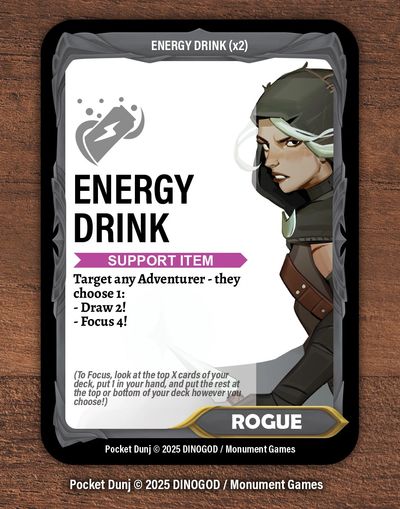
Cards with a Support Item actions benefit the Adventurers in crucial ways! All Adventurer decks contain at least 1 support item. As they are not Skills or Spells, then Chief cannot interfere with their usage except in very rare cases! They are otherwise played like any other cards!
The rules text for the mechanics often provided by Support Items (such as Focus and Adapt) are always at the bottom of the card!
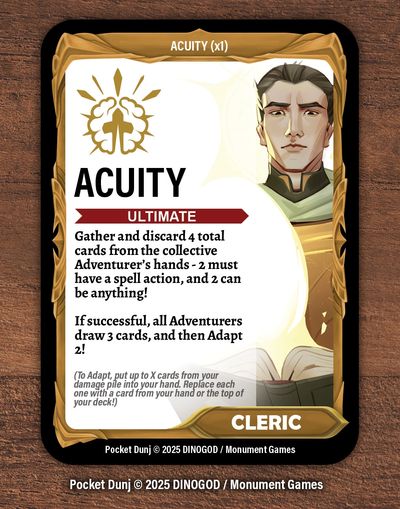
Within every Adventurer deck is one distinct card with an Ultimate action! Ultimate actions are very powerful effects that require a sacrifice from the party in the form of a collective discard that any and all Adventurer can contribute to. If the discard requirements are met, the effect resolves!
If an Adventurer plays their Ultimate action and then finds out the requirements cannot be met, they retain the card!
Monster cards are placed into the Dunj near the Adventurer of the Chief’s choice. That Adventurer is considered “engaged” by that monster - generally this means it will damage and/or affect that specific Adventurer in the Dunj Phase, but some monsters can create problems outside their engagement!
No Adventurer can be engaged to a 2nd monster until all non-injured Adventurers have a monster engaged to them!
No Adventurer can have 3 or more monsters engaged to them!
There are 3 types of monsters:

Grunt Monsters are the standard types of monsters that occupy the Dunj.

Elite Monsters are powerful versions of Grunt Monsters that are much rarer.

Boss Monsters are the most powerful foes that exist in Final Act Decks.
Trap cards are placed into the middle of the Dunj, where they will affect the Adventurers in the Dunj Phase according to their text! Traps, like monsters, remain in the Dunj unless otherwise stated by a card!
Some monsters and traps have an “On Play” effect.
These effects occur at the beginning of the encounter. The Chief resolves these before the encounter goes live.
Note that if a card puts a monster or trap with an On Play effect into the Dunj, the On Play effects are triggered unless otherwise stated by a card!
The Chief’s event cards are played at the start of Encounters just like monsters and traps - an Encounter can even be just an Event card! Unless otherwise stated by card text, events are discarded after resolving!
The Adventurer’s events are played like any other Adventurer card!
Some cards have reactions that may be played when the conditions of the reaction have been met! Unless otherwise stated by card text, they are discarded after resolving!
The Chief and Adventurers cannot see each other’s hands unless a played card permits it. However, Adventurers can and should show each other cards and speak among themselves about the cards they have and their strategic intent. But they must be careful not to reveal too much to the Chief!
Certain Pocket Dunj cards resolve their effects by having 2 players compete against each other in a game of Rock Paper Scissors. The stakes are always declared on the card! Unless otherwise stated, ties are replayed, and only 1 win is required.
You may play Rock Paper Scissors in accordance with your local customs, but we do encourage playing on the 3rd beat instead of the 4th to save time!
A combat begins when Adventurers start playing damage dealing cards against a monster in the Dunj! A combat must resolve before another begins!
Regardless of engagements, any Adventurer can play cards in any combat unless a card in play says otherwise!
Adventurers place their damage dealing cards face up in the Dunj and leave them there until the combat has resolved. The Chief may react to any of these cards like normal - if they play a card that negates one of the Adventurer’s damage dealing cards, combat continues!
If the Adventurers decide at any point they can’t or won’t destroy the monster they started combat with, they retain their cards and put them back in their hand!
When a monster has received damage equal to or greater than their life value, it is considered defeated, and goes into the Chief’s discard pile! Note that some Adventurer cards can outright destroy monsters, and even traps!
All Or Nothing: A monster that is not defeated in combat remains in the Dunj at full life - no monster can be partially damaged outside of combat!
Monster Hop: When any monster injures an Adventurer with its damage, or does damage to an injured Adventurer, the Chief may immediately re-engage it to any other Adventurer - provided that Adventurer doesn’t already have 2 monsters engaged to it!
Certain monsters and traps interact with these different keywords in specific ways, particularly with immunity!
Certain monsters and traps cannot be shoved or destroyed by cards that shove and/or destroy! These immunities are indicated by large X symbols near the monsters life and damage values.
Monsters and traps in the Chief’s hand, deck, or shove pile maintain these immunities! If, for example, an Adventurer card is allowing you to look in the Chief’s hand and destroy a monster, a monster with immunity to destroy cannot be destroyed!
Additionally, if the Chief is in a situation where they must target a monster to be shoved or destroyed, they may not select a monster immune to Shove or Destroy in order to escape that decision! They must target eligible cards in all circumstances, if possible!
There are 3 universal mechanics in Pocket Dunj represented by keywords. All of these keyword descriptions can also be found near the bottom of any card that contains them!
When an Adventurer is damaged, they take cards equal to the amount of damage they took off the top of their deck and put them into their damage pile. Ideally, they do this in stacks of 5 so it is easily visible to all players how damaged they are.
When any Adventurer has received the amount of damage that the Chief is required to do to each Adventurer, the controlling player flips the Adventurer card over to the “Injured” side, and immediately discards 1 card!
Crucially, injured Adventurers continue to play like normal until the end of the game, but they have -1 hand size!
When the Chief goes to draw a card from their deck and there are none left, the “The Final Act” begins!
The Chief takes the Final Act deck and whatever cards are in the shove pile and shuffles them into a new Dunj deck. Then the Chief resumes their draw!
During The Final Act, gameplay continues as normal with one exception - shoved cards are now destroyed!
Text on cards sometimes conflicts with the text in the official rulebook! This is intended, and in these conflicts, the cards always supersede the rules!
The Chief is fully responsible for keeping the game moving and resolving timing disputes, but they must also give the Adventurers the space to act fully and strategically!
1 or more Adventurers that hoard their cards in an attempt to play them in the most ideal circumstances are, more often than not, harming the party and slowing down the game! If you witness this behavior, encourage them to play their cards more aggressively!
The Chief is encouraged to flavor the card interactions (within reason) in order to tell the best possible Pocket Dunj story!
“Look Chiefs, here’s the deal. Throughout these onboarding materials I’m talkin’ a big talk about wrecking Adventure face, making them wish they were never born, killing them slowly with scorpions, etc. But that’s just marketing.
Truthfully, we don’t WANT to murder Adventurers. We don’t want to set the realm on fire, or eradicate humankind, or take over the world. We want to make money. And we can’t do that if we slaughter Adventurers left and right.
Your actual goal is not to crush them, it’s to delight them. To create conflict and generate stress. To give them a story to tell.
Sure, you want to hurt them physically and emotionally, damage their egos, poison them mentally…but they’ll survive all that, and that’s good! They’ll keep on trying, keep buying our gear, keep paying our bills, and have disgusting little Adventurer babies that will do the same thing in the future.
Make the story of their stupid little adventure awesome. Make them -addicted- to their own glory.
Make them want more so badly they beg for punishment and return to the Dunj over and over.
Make us RICH.”
-Dev (The Dunj Devil, CEO of Dunj Incorporated)
Copyright © 2019 DINOGOD LLC - All Rights Reserved.
POWERED BY INFINITE PRIMEVAL GNASHING AND UNITY